
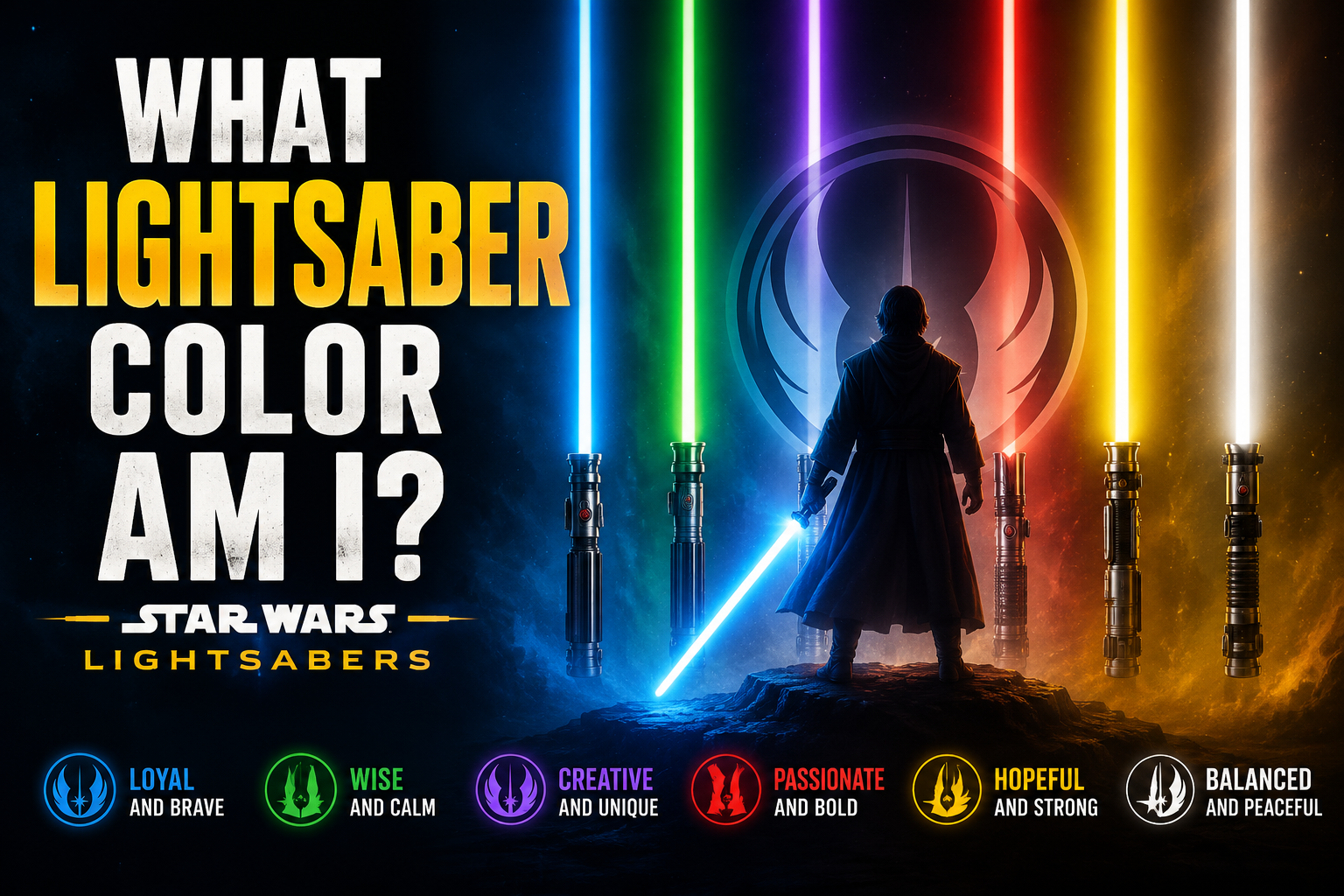
What Lightsaber Color Am I? Star Wars Lightsabers
What Lightsaber Color Am I? Find Your Star Wars Lightsaber Match
Why Lightsaber Colors Matter
A lightsaber isn’t just a weapon — it’s a mirror. In canon, the color that glows from a blade comes from the kyber crystal inside, and that crystal responds to the wielder’s connection to the Force rather than a factory setting or a personal whim. A Jedi doesn’t choose blue because it looks sharp; the crystal reacts to their temperament, their intentions, and how they hold their convictions under pressure. Recent shows have pushed this idea further than ever: Ahsoka gave us villains wielding orange blades instead of the expected red, and The Acolyte showed a crystal turning from blue to red on screen as a character’s grief curdled into rage. That’s what makes a lightsaber color quiz genuinely interesting — it’s asking what kind of person you are when things get tense, not just which color you’d pick off a shelf.
What Does a Blue Lightsaber Mean?
Blue is the signature color of Jedi Guardians — those who lean on discipline, courage, and direct action rather than quiet study. If your result is blue, you’re likely someone who values clarity: you’d rather confront a problem head-on than let it fester. Blue-aligned personalities tend to be dependable under pressure, loyal to the people they’ve chosen to protect, and uncomfortable with ambiguity. You’re not reckless, but you’re not passive either — you act once you’ve decided something is right. The trade-off is that this directness can tip into rigidity if you’re not careful, since blue types sometimes force a resolution instead of sitting with uncertainty a little longer.
What Does a Green Lightsaber Mean?
Green belongs to the Jedi Consulars — the thinkers, negotiators, and healers of the Order who favor wisdom over confrontation. A green result suggests you process situations before reacting, and you’d rather talk your way to a solution than swing a blade at it. People with this alignment tend to be reflective, empathetic, and genuinely curious about other perspectives, which makes them strong mediators in conflict. Green types aren’t weak — they’re strategic, often seeing several moves ahead while others are still reacting emotionally. The challenge is that this patience can look like hesitation to people who want faster answers, even when your read on the situation is the more accurate one.
What Does a Red Lightsaber Mean?
Red lightsabers are built differently — through a “bleeding” ritual rather than a natural attunement, and that process itself says something. If red is your result, you’re likely intense, driven, and unwilling to let obstacles set your pace. This isn’t automatically about villainy; it’s about raw will overriding hesitation. Red-aligned personalities often channel strong emotion into forward motion instead of suppressing it, which can make you formidable but also unpredictable. You tend to trust your instincts over consensus, and you’re rarely the person waiting for permission. The risk is burning bridges — or yourself — out when that intensity isn’t paired with self-awareness.
What Does a Purple Lightsaber Mean?
Purple is rare and deliberately paradoxical — most famously tied to a Jedi Master who balanced restraint with a willingness to draw on darker instincts when necessary. A purple result suggests you don’t fit cleanly into “good” or “bad” boxes, and you’re comfortable with that. You likely weigh outcomes over ideology, willing to bend a rule if the alternative causes more harm. A newer example in canon is a younger Jedi Knight who modified her purple blade into a flexible lightwhip, showing that this alignment isn’t just philosophical — it can be inventive, too. It takes real self-control to hold this balance without tipping fully into one side, which is exactly why purple stays uncommon.
What Does a Yellow Lightsaber Mean?
Yellow was long associated with Jedi Temple Guards, but a major sequel-era hero later carried it as a symbol of forging a new path rather than repeating the old one. If you land on yellow, you’re probably someone who notices details others miss and prefers preparation over improvisation. This alignment suggests vigilance, patience, and a strong internal compass, paired with a willingness to build something new instead of just preserving tradition. Yellow types make excellent long-term planners and reliable allies, precisely because they’ve usually thought through the worst case before anyone else brings it up.
What Does an Orange, White, or Black Lightsaber Mean?
These colors sit outside the traditional Guardian-Consular-Sith framework, and each one has grown a lot more screen time in the last two years:
- Orange — worn by two fallen Jedi in a recent Disney+ series, signaling loyalty to neither the Jedi nor the Sith but to something more personal and ambiguous.
- White — the result of purifying a corrupted crystal, most famously achieved by a former Jedi who reversed the bleeding process through patience rather than combat.
- Black — the one-of-a-kind Darksaber, tied to Mandalorian leadership rather than the Jedi or Sith at all, and won through combat rather than crystal attunement.
If you land here, your result is telling you that you don’t follow a template — you build your own rules and answer to your own sense of right and wrong.
Fun Facts About Lightsaber Colors
- Kyber crystals are naturally colorless until they bond with a Force-sensitive wielder, meaning the color is a byproduct of connection, not choice.
- Sith don’t attune to crystals — they corrupt them into red through bleeding, a process finally shown step-by-step on screen in a recent live-action series rather than only described in books.
- Orange has no official symbolic meaning in canon; it was chosen for two Ahsoka villains specifically to signal an allegiance that isn’t clearly Jedi or Sith.
- A colorless, mood-reactive lightsaber concept — where the blade shifts in real time with the wielder’s emotional state — is central to a new 2026 anime spin-off, offering a stylized, non-canon take on the same idea bleeding and purification represent in the main timeline.
Frequently Asked Questions
What does my lightsaber color say about my personality?
Your result reflects a dominant trait rather than your entire personality — think of it as your default mode under pressure. Blue suggests direct action, green suggests reflection, red suggests intensity, and rarer colors suggest you resist easy categorization. It’s meant to be a fun, symbolic snapshot, not a rigid label, so don’t be surprised if you relate to traits from more than one color depending on the situation you’re in.
Can Jedi choose their lightsaber color?
Not really — at least not the way people assume. A Jedi doesn’t hand-pick a shade like choosing a paint color; the kyber crystal responds to the wielder during a bonding process, and the resulting hue reflects that connection. This is part of why the quiz format works so well: it mimics the same idea of an outcome shaped by who you are, not by preference.
What is the rarest lightsaber color?
White and black remain the rarest in canon. White typically results from purifying a corrupted crystal after real hardship, and it’s associated with only one major character. Black belongs to the singular Darksaber, which changes hands through combat rather than attunement. Orange is also uncommon, currently tied to just two named characters in canon television.
Is red always evil in Star Wars?
Not necessarily, though it’s the strongest visual shorthand for the dark side. Red comes from the crystal-bleeding process tied to Sith users, but the color doesn’t guarantee alignment — it signals intensity and will more than morality. If your result is red, it’s pointing at your drive and emotional intensity, not suggesting you’re destined for villainy.
How accurate is this lightsaber quiz?
It’s designed for fun and self-reflection rather than clinical precision. The questions map real personality patterns — how you handle conflict, what motivates you, how you make decisions — onto Star Wars’ color symbolism. Treat your result as a lighthearted mirror rather than a definitive verdict, and feel free to retake it later to see if your answer shifts.