How AI Is Changing the Way People Create Brand Logos
How AI Is Changing the Way People Create Brand Logos
Ten years ago, getting a logo made meant hiring a designer, waiting days for concepts, and paying anywhere from a few hundred to several thousand dollars. Today, a founder can type a sentence describing their brand and have a dozen logo concepts in under a minute. The AI logo generator market has grown from roughly $0.59 billion in 2025 to about $0.73 billion in 2026, and it’s on track to hit $1.65 billion by 2030. That growth isn’t just about speed — it’s changing who gets to participate in branding at all. This article breaks down how AI logo generation actually works, why so many businesses are adopting it, where it still falls short compared to human designers, and how to get genuinely usable results out of these tools right now.
What Is AI Logo Design and How Does It Work?
AI logo design uses generative models trained on massive datasets of existing logos, typography, and color theory to produce new designs from a simple text description. Instead of starting with a blank canvas, the system starts with patterns it has learned about what makes a mark feel like a “tech brand” or a “vintage bakery.” The user describes their business, picks a style direction, and the AI outputs several visual directions to choose from. What used to require design training now requires clear communication — the skill has shifted from drawing ability to knowing how to describe what you want.
The Technology Behind AI Logo Generators
Most modern tools rely on diffusion models — the same underlying technology behind popular AI image generators. These models are trained on huge libraries of logos, icons, and brand marks, learning the relationships between shapes, color palettes, and typography styles. When given a prompt, the model doesn’t copy an existing logo; it generates a new image by predicting pixels that match the described style. Some platforms layer a second system on top that converts the raster output into clean vector files, since logos need to scale from a business card to a billboard without losing quality.
From Prompt to Logo — The Generation Process
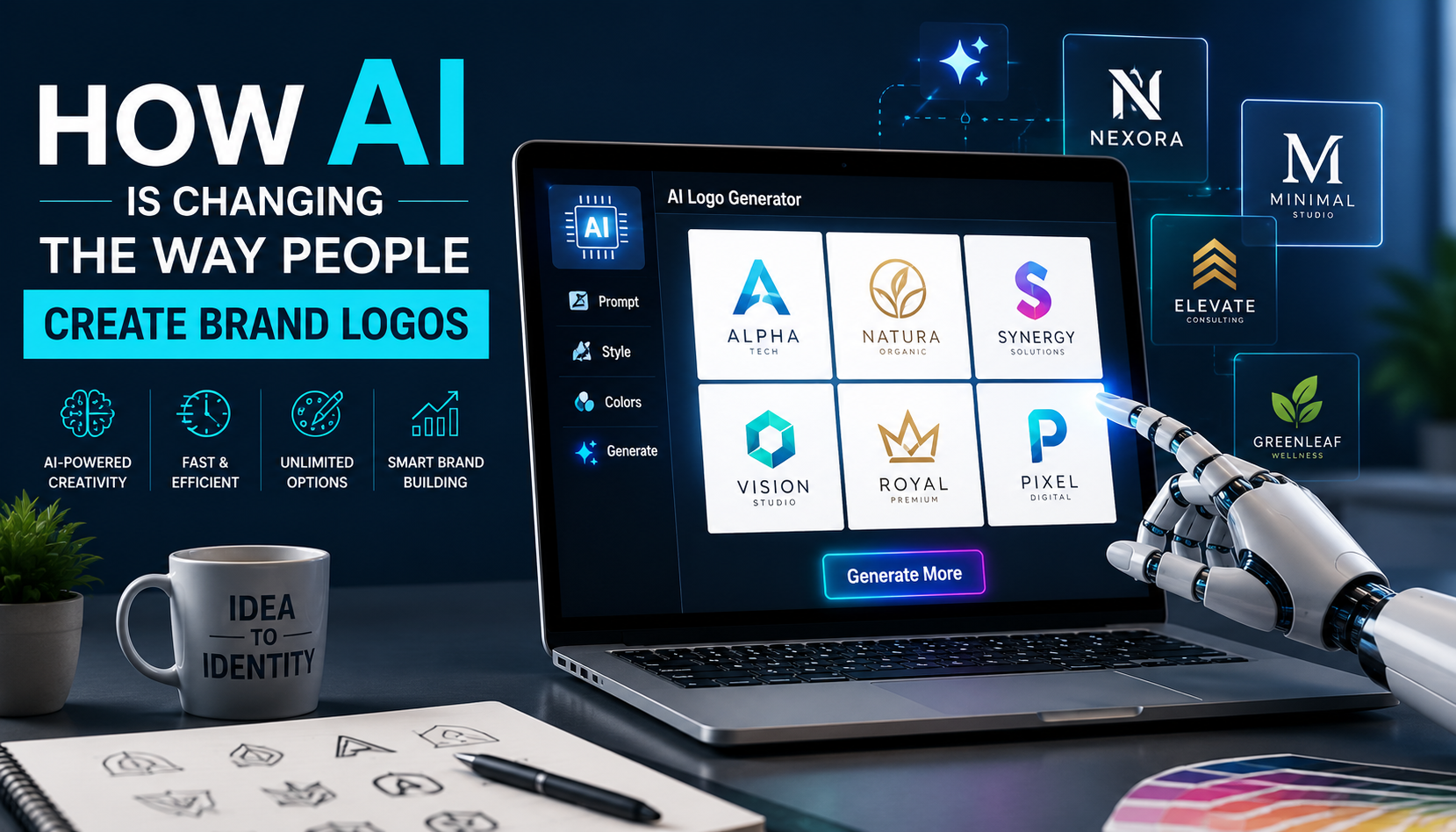
The typical workflow starts with a text prompt describing the business, industry, and desired feel (modern, playful, luxury, minimal). The tool then generates multiple concept variations, usually 4 to 12 at once, each testing a different layout or symbol. Users select a favorite, then refine it further — adjusting colors, swapping icons, or regenerating with tweaked wording. Some platforms let users upload a reference image or existing brand asset to guide the style. The process is iterative rather than linear, closer to sculpting than sketching.
Why Businesses Are Turning to AI for Logo Design
The appeal comes down to three things most small businesses care about most: cost, speed, and accessibility. A freelance designer might charge $300–$2,000 and take one to two weeks with revision rounds. AI tools compress that into minutes at a fraction of the cost, sometimes free. This matters most for people who aren’t ready to invest heavily in branding yet — a new e-commerce seller testing a product idea, or a solo consultant launching a website this weekend. AI removes the financial and time barrier that used to gatekeep professional-looking visual identity.
An estimated 40% of small businesses are already using some form of AI for their visual branding, and AI-powered tools have cut logo design turnaround times by up to 50% compared to traditional workflows.
Speed and Cost Advantages Over Traditional Design
Traditional logo design involves briefing a designer, waiting for initial concepts, and going through multiple revision cycles — often a two-to-three week process minimum. AI generators collapse that timeline into a single session. Because there’s no hourly billing or revision fee structure, users can regenerate endlessly at no extra cost, testing dozens of directions before settling on one. For businesses operating on tight runway, this reallocates budget toward marketing or product instead of upfront branding — though it does trade away the strategic discovery process a human designer typically brings.
Accessibility for Startups and Solopreneurs
Many founders launching their first business have no design background and no budget for one. AI logo tools lower that barrier by translating plain language into visual output, no software skills required. A person selling handmade candles on Etsy can have a professional-looking mark before their first sale, without learning Illustrator or hiring anyone. This has quietly expanded who gets to look “legitimate” online — previously, polished branding signaled bigger budgets; now it signals knowing which tool to use.
Top AI Logo Design Tools in 2026
The AI logo space has matured fast, splitting into two clear categories: quick-generation tools built for speed and simplicity, and advanced platforms aimed at users who want more creative control over the output. Beginner-friendly tools tend to prioritize a clean, guided flow — pick an industry, describe a vibe, choose from generated options. Advanced tools add layered editing, custom vector controls, and brand kit generation (business cards, social templates, color systems) built around the chosen logo. Which category fits depends less on budget and more on how much creative input the user wants to retain.
Best Tools for Beginners
Beginner-oriented platforms focus on removing decisions rather than adding them. Users typically answer a short series of prompts — industry, style preference, color leaning — and receive ready-made concepts within seconds. Editing tools are simplified to sliders and swap options rather than open-ended design controls. This category works best for someone who wants a decent logo fast and doesn’t plan to obsess over typography kerning or icon symbolism. The tradeoff is less uniqueness, since outputs draw from more constrained style templates.
Best Tools for Advanced Customization
More advanced platforms give users granular control: adjusting individual vector points, layering multiple icon elements, fine-tuning typography pairings, and exporting full brand systems rather than a single file. These tools suit agencies, growing brands, or anyone who wants the AI to handle the heavy lifting of ideation while retaining hands-on control over the final execution. They typically have a steeper learning curve and often sit behind a paid tier, but the output tends to look less templated and more brand-specific.
AI vs. Human Designers — Strengths and Limitations
AI and human designers aren’t really competing for the same job anymore — they’re suited to different stages of brand development. AI wins on speed, cost, and sheer volume of options; a human designer wins on strategic thinking, originality, and understanding the nuance of what a brand is trying to say beyond its visual style. The strongest results in 2026 often come from a hybrid approach: using AI to rapidly explore directions, then bringing in human judgment to refine, differentiate, and legally clear the final mark.
What AI Does Better
AI dramatically outperforms humans on iteration speed — generating and discarding dozens of concepts costs nothing and takes seconds. It’s also consistent at applying design theory (color harmony, balanced spacing, readable typography pairings) since those rules are baked into training data. For businesses that need “good enough, fast,” this consistency is a real advantage over a single designer’s individual style or availability. AI also removes the awkwardness of giving feedback, since users can simply regenerate instead of navigating a revision conversation.
Where Human Designers Still Have the Edge
Human designers understand context AI can’t infer from a prompt — company history, competitor positioning, cultural nuance, and long-term brand strategy. They can also guarantee originality in a way AI currently can’t, since generative models draw on patterns from existing designs and can produce logos that unintentionally resemble other brands. For companies planning significant investment in brand recognition or trademark protection, a human designer’s ability to create something defensibly unique still outweighs AI’s speed advantage.
Common Challenges and Risks of AI-Generated Logos
The convenience of AI logo generation comes with real tradeoffs that don’t always surface until after a business has committed to a mark. Originality and trademark risk sit at the top of the list, followed by a visual sameness that’s becoming increasingly recognizable across AI-generated brands. Businesses planning to build long-term brand equity — not just a placeholder logo — need to weigh these risks before finalizing a design, since fixing a trademark conflict or rebrand later is far more costly than getting it right upfront.
Originality and Trademark Concerns
Because AI models generate output based on patterns learned from existing logos, there’s a real possibility of producing a mark that closely resembles another company’s branding — sometimes without either party realizing it. Recent court rulings on AI-generated visual content, including a 2025 UK High Court decision involving Stable Diffusion outputs, show regulators are actively working through where AI authorship and infringement lines sit. Businesses planning serious brand investment should run a trademark search before committing, regardless of how the logo was created.
Avoiding Generic, “AI-Look” Designs
As AI logo tools have grown more popular, certain visual patterns — specific gradient styles, geometric abstractions, particular icon-and-wordmark layouts — have become instantly recognizable as “AI-generated.” This creates a paradox: the tool meant to help a brand stand out can make it blend into a growing crowd of similar-looking AI logos. Combating this requires deliberately steering prompts away from popular default styles, combining multiple AI passes, or using AI output only as a starting sketch that gets meaningfully reworked afterward.
How to Get the Best Results From an AI Logo Generator
Getting a genuinely usable logo out of an AI tool has less to do with the platform chosen and more to do with how the request is framed. Vague prompts produce vague, generic results; specific, detail-rich prompts produce sharper, more brand-appropriate concepts. Treating the first output as a rough draft rather than a final answer — and planning at least one round of manual refinement — consistently produces better results than accepting the first generation at face value.
Writing Effective Logo Prompts
Strong prompts include the industry, target audience, desired emotional tone, and any specific visual elements to include or avoid. Rather than a single adjective like “modern,” effective prompts describe a feeling with context:
- Name the industry and audience (e.g. “eco-conscious skincare brand for millennials”)
- Describe tone with specifics (“clean and minimal,” “warm and handcrafted”)
- Call out what to avoid (“no generic globe icons,” “no gradient effects”)
- Reference an aesthetic direction without asking for a direct copy
Refining AI Output for a Polished Final Logo
Once a strong concept emerges, refinement should focus on details AI often gets slightly wrong: letter spacing, icon-to-text balance, and color contrast across different backgrounds. Exporting the file as a scalable vector and testing it small (favicon size) and large (signage size) reveals issues invisible at default preview size. Many businesses take the AI concept to a freelance designer for a final polish pass — a hybrid approach that keeps costs low while still catching the details a purely automated process tends to miss.
The Future of AI in Branding and Visual Identity
The next phase of AI branding is moving beyond a single static logo file. Industry forecasts suggest most design platforms will fold AI logo features into their core product within the next couple of years, and full brand-system generation — logo, palette, typography, social templates, and packaging mockups produced together for consistency — is becoming the norm rather than a premium add-on. Adaptive and animated logos that shift subtly based on context (dark mode, video intros, app icons) are also gaining traction as brands live primarily on screens rather than print. The likely long-term shape of the industry isn’t AI replacing designers, but a layered workflow where AI handles rapid exploration and humans handle strategic refinement and originality checks.
Frequently Asked Questions
Is an AI-generated logo legally mine to use?
In most cases, yes — most AI logo platforms grant usage rights once you’ve generated and purchased the design, similar to buying a stock asset. However, ownership terms vary by platform, so it’s worth checking the specific service’s licensing terms before committing to it as your primary brand mark, especially for commercial or trademark purposes.
Can AI logos be trademarked?
Generally yes, if the logo is sufficiently distinctive and doesn’t infringe on existing trademarks. The bigger risk isn’t AI authorship itself — it’s the possibility that the design closely resembles another registered mark, since AI models draw on patterns from existing logos. A trademark search before filing is strongly recommended.
Are AI logo generators free?
Many offer a free tier for generating initial concepts, but usually charge for high-resolution downloads, vector files, or full brand kits. Pricing models vary widely, from one-time purchases to monthly subscriptions. It’s worth comparing what’s actually included in a “free” logo before assuming it’s usable for commercial purposes.
Do AI logos look unprofessional or generic?
Not inherently, but certain default styles have become recognizable as “AI-generated” due to overuse. Quality depends heavily on prompt specificity and whether the output gets refined afterward. A well-prompted, manually polished AI logo can look entirely professional; a first-draft output accepted as-is is more likely to look generic.
Should startups use AI or hire a designer?
It depends on stage and budget. Early-stage startups testing an idea often benefit from AI’s speed and low cost. Businesses planning significant brand investment or long-term recognition typically benefit more from a human designer’s strategic input and originality guarantees, sometimes using AI-generated concepts as a starting reference point.