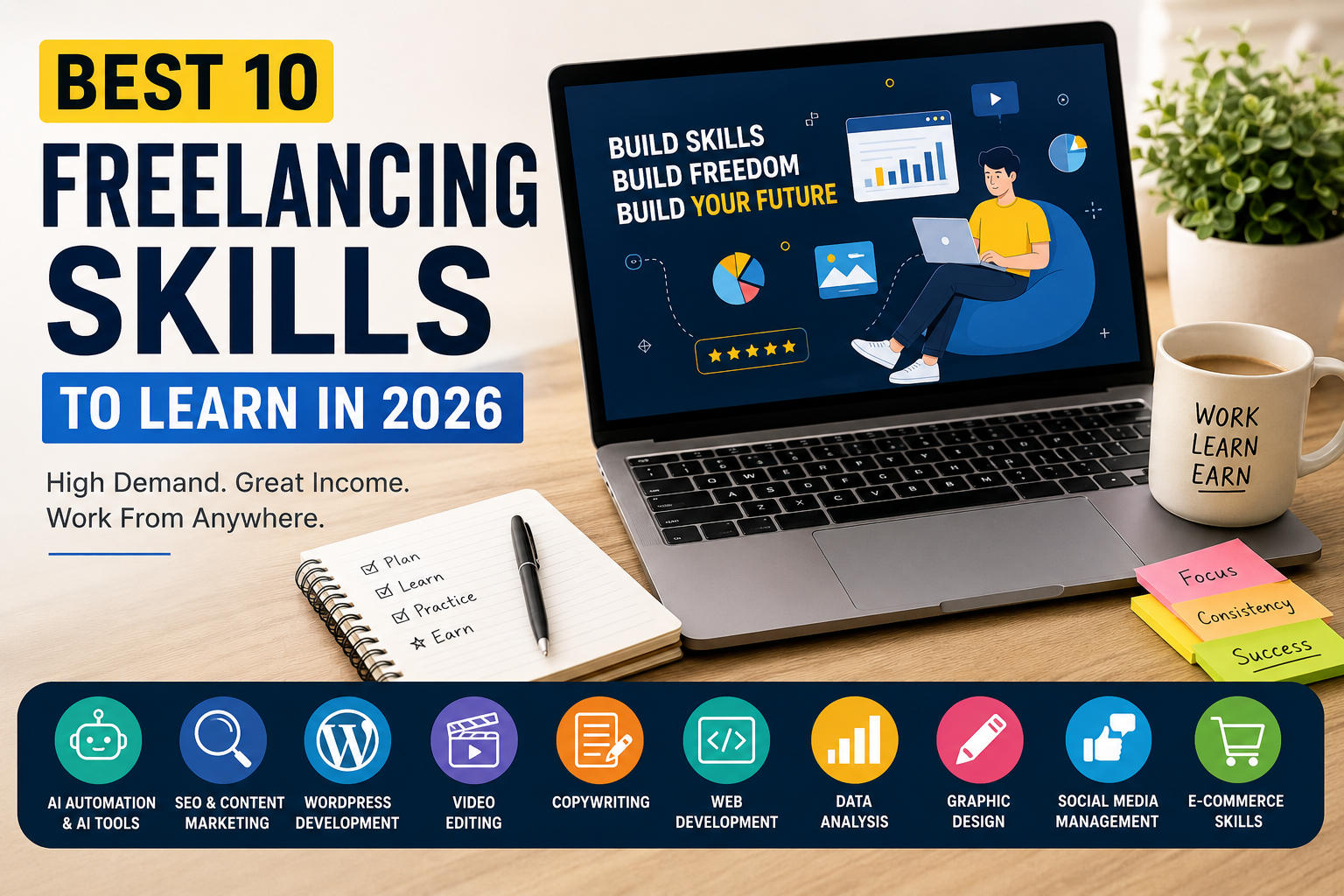
Best 10 Freelancing Skills to Learn
The freelance economy has crossed a new threshold. Global freelance spend is now estimated at roughly $1.57 trillion, and AI-related freelance work grew 109% year-over-year on major platforms. But “learn AI” is no longer enough of a strategy on its own — clients are hiring for specific, provable outcomes. This guide breaks down the ten freelance skills worth investing in right now, what they actually pay in 2026, and how to start building real proof of work in each one. (For more career and side-income guides like this one, visit NamesIdeaz.)
Why Choosing the Right Skill Matters More Than Ever
The freelance market doesn’t reward breadth anymore — it rewards depth that’s hard to automate. Generic services like basic data entry, template graphic design, and unedited AI-generated copy are shrinking as clients realize they can get that output themselves in seconds. What’s growing fast is anything that combines a tool with judgment: someone who can direct AI rather than compete with it.
That shift changes how you should pick a skill. Instead of asking “what’s popular,” ask “what decision or output still needs a human to own it.” A focused freelancer who can demonstrate real results in one lane will consistently out-earn a generalist who dabbles in five.
Clients aren’t paying for tasks anymore — they’re paying for outcomes they can’t easily produce themselves. The freelancers winning in 2026 are the ones who can say, in one sentence, exactly what business problem they solve.
- Access to clients in nearly every country, paid in your currency of choice
- Stronger income ceiling for specialists than generalists in the same field
- Full control over schedule, workload, and which projects you take
- A skill set that compounds — each project adds to a portfolio that sells the next one
- Long-term resilience as routine tasks get automated around you
How Freelance Income Actually Gets Built
Freelancing income rarely comes from a single platform listing. It’s built from a portfolio, a niche, and a reputation that compounds over time. Clients hire independent talent because it’s faster and cheaper than building an in-house team for a specific need — which means your job is to make that “specific need” instantly recognizable in your profile and portfolio.
- Build 3–5 portfolio pieces that mirror real client problems, not tutorials
- Take on smaller starter projects to generate reviews and case studies
- Get specific about who you serve — “SEO for SaaS companies” beats “SEO services”
- Learn to scope and price work, not just do it
- Treat every delivered project as a future referral
2026 Freelance Skills Comparison
| Skill | Learning Curve | Market Demand | Typical Rate Range |
|---|---|---|---|
| AI Automation & Applied AI | Medium | Very High | $30–$130/hr |
| SEO & AI Search Optimization (GEO) | Medium | High | $25–$90/hr |
| WordPress & No-Code Website Development | Easy–Medium | High | $20–$70/hr |
| AI-Assisted Video Editing | Medium | Very High | $20–$80/hr |
| Strategic Copywriting & Brand Voice | Medium | High | $25–$100/hr |
| Web & App Development | Hard | Very High | $35–$150/hr |
| Data Analysis & Data Science | Medium–Hard | High | $35–$160/hr |
| Graphic & Brand Design | Easy–Medium | Shifting | $15–$60/hr |
| Social Media & Content Systems | Easy–Medium | High | $15–$50/hr |
| E-commerce & Marketplace Management | Medium | High | $20–$70/hr |
1. AI Automation & Applied AI — The Skill Reshaping Every Other Skill
AI automation has moved from “nice to have” to the default expectation in almost every freelance category. Businesses don’t just want someone who can use ChatGPT or Claude — they want freelancers who can connect AI models to real workflows: routing leads, drafting reports, triaging support tickets, or building lightweight internal agents. This is no longer a niche for developers; marketers, writers, and operations freelancers increasingly need to know how to wire these tools into a client’s daily processes.
Why It’s Worth Learning
- AI-related freelance work has grown faster than almost any other category in the past year
- Cuts across marketing, operations, customer support, and content teams
- Rewards people who understand a business process, not just a tool
- Pairs naturally with almost every other skill on this list
Not a chatbot demo — a system that removes hours of manual work each week and is documented well enough that someone on their team can maintain it.
How to Learn It
- Get fluent in a leading assistant (Claude, ChatGPT, Gemini) and strong prompt design
- Learn one automation platform deeply — n8n, Make, or Zapier — rather than skimming all three
- Practice connecting AI outputs to real tools: spreadsheets, CRMs, inboxes
- Build two or three small automations for a real (even unpaid) use case
- Document the before/after time saved — that number sells the next client
2. SEO & AI Search Optimization (GEO) — Visibility in a Search Landscape That’s Changed
Traditional SEO hasn’t gone away, but it now shares the stage with generative engine optimization — making sure content gets surfaced inside AI-generated answers and overviews, not just blue links. Freelancers who understand both classic ranking factors and how AI search engines select and cite sources are positioned ahead of SEO generalists.
Why It’s Worth Learning
- Every business with a website still needs organic visibility
- AI Overviews and chat-based search are changing how content gets discovered
- Skills compound with content strategy and copywriting
- Outcomes are measurable, which makes retainers easier to justify
How to Learn It
- Master keyword research and search intent fundamentals
- Learn how AI search tools select, summarize, and cite content
- Study technical SEO basics: site speed, structured data, crawlability
- Run a personal project or case study site to test strategies
- Track and report results in a way clients can actually understand
3. WordPress & No-Code Website Development — Still the Easiest Entry Point
WordPress still powers a huge share of the web, and no-code builders have made it realistic for a beginner to deliver a professional site within weeks, not years. The opportunity now is layering in speed optimization, accessibility, and light AI-assisted personalization on top of the basics — that’s what separates a $300 website gig from a $3,000 retainer client.
How to Learn It
- Learn hosting, domains, and WordPress installation basics
- Get comfortable with themes, plugins, and a builder like Elementor
- Learn core site speed and security practices
- Build three to five demo sites across different industries
- Offer ongoing maintenance as a recurring add-on
4. AI-Assisted Video Editing — The Single Fastest-Growing Creative Skill
Short-form video keeps eating attention, and a new wave of AI video generators has created an unexpected freelance niche: shaping raw AI-generated footage into something usable. Clients are producing clips with tools like Runway or Sora and need editors who understand pacing, sound design, and platform-native formatting to turn that raw output into finished content.
How to Learn It
- Learn an editor — CapCut, Premiere Pro, or DaVinci Resolve
- Get familiar with at least one AI video generation tool
- Study cuts, pacing, captions, and sound design for short-form content
- Re-edit existing public content as practice reps
- Build a reel that shows range: ads, talking-head, narrative
5. Strategic Copywriting & Brand Voice — Writing That Survives the AI Flood
Generic AI-generated copy is now cheap and everywhere, which has pushed demand toward writers who can do what AI still struggles with: develop a distinct brand voice, build a content strategy, and write with real positioning. The freelancers earning well in this space aren’t typing faster — they’re thinking like strategists who happen to write.
How to Learn It
- Study high-performing ads, landing pages, and email sequences
- Practice writing in distinct brand voices, not just “good grammar”
- Learn the basics of funnels and customer psychology
- Use AI tools as a first draft, not a final product
- Build a portfolio organized by outcome, not just by format
6. Web & App Development — Still the Highest Ceiling
Development remains one of the steadiest, highest-paying freelance paths, and demand keeps climbing as more products get built with AI assistance baked in. Developers who can integrate AI features — chat interfaces, recommendation logic, automation — into real applications are seeing the strongest hiring interest of any technical niche.
How to Learn It
- Master HTML, CSS, and JavaScript fundamentals
- Learn a modern framework such as React
- Practice integrating APIs, including AI APIs
- Ship real projects, not just tutorials
- Build a portfolio that shows production-ready code, not demos
7. Data Analysis & Data Science — The Quiet, Durable Demand
As more businesses sit on growing piles of data, the ability to turn that data into a clear decision remains one of the most consistently valuable freelance skills. Freelancers who pair data fluency with a specific industry — finance, e-commerce, healthcare — tend to out-earn generalist analysts.
How to Learn It
- Get strong in Excel or Google Sheets first
- Learn SQL fundamentals
- Learn a visualization tool like Power BI or Tableau
- Practice on public datasets relevant to a target industry
- Package findings into clear, decision-ready reports
8. Graphic & Brand Design — Adapting to an AI-Saturated Market
Basic, template-style design work has gotten noticeably harder to sell — AI tools now generate passable logos and social graphics in seconds. The designers still in demand are the ones building full brand systems, motion design, and original visual identity work that AI alone can’t reliably produce. That extends to physical branding too: designers who understand finishing techniques like UV coating for packaging and print collateral can offer clients a more complete, tactile brand experience than a purely digital designer.
Demand for generic, off-the-shelf design work has been declining. Designers who move toward brand strategy, original illustration, or AI-assisted (not AI-replaced) workflows are the ones holding their rates.
How to Learn It
- Learn design fundamentals: layout, color theory, typography
- Get fluent in Figma or Photoshop, plus an AI image tool
- Practice full brand systems, not single assets
- Study what makes a design memorable, not just clean
- Build a portfolio around outcomes — recognition, conversion, consistency
9. Social Media & Content Systems — From Posting to Strategy
Posting content manually is being automated away; what clients now pay for is the strategy layer — content calendars, audience research, and reporting that ties activity back to growth. Freelancers who can run a system, not just a feed, are the ones landing recurring retainers.
How to Learn It
- Study how each major platform’s algorithm rewards content
- Learn content planning and batching workflows
- Get comfortable with scheduling and analytics tools
- Practice building a 30-day content calendar from scratch
- Learn to report results in terms a business owner cares about
10. E-commerce & Marketplace Management — Running the Back End of Online Selling
Online selling keeps growing, and store owners increasingly outsource everything from product listings to conversion optimization. Freelancers who understand both the technical side (Shopify, inventory, integrations) and the marketing side (listings, retention, ads) become long-term operational partners rather than one-off hires. Good product research skills transfer across almost any niche — the same due-diligence approach used to evaluate whether budget disposable vapes are worth it applies just as well to vetting any other trending consumer product before recommending it to an e-commerce client.
How to Learn It
- Learn Shopify or a comparable platform end to end
- Study product research and listing optimization
- Practice conversion-rate optimization basics
- Learn the fundamentals of retention and email marketing
- Build a demo store to show real, working setup skills
Key Takeaways
- AI fluency is now table stakes across nearly every freelance category, not a separate niche
- Generic, template-based work is losing ground fastest — depth and specificity win
- Pick one skill, build real proof of work, and expand from a position of strength
- Pair a technical skill with a niche industry for faster trust and higher rates
- Document outcomes (time saved, revenue moved, traffic gained) — that’s what actually sells
How to Choose the Right Skill for You
There’s no universal “best” skill — only the best fit for your current experience, available time, and what you can realistically practice on real projects. Resist the urge to learn five things at once; a focused freelancer who’s genuinely good at one valuable skill will out-earn a generalist almost every time.
- What you already have some experience or natural interest in
- How much consistent time you can give it over the next 3–6 months
- Whether the skill is growing or shrinking in current market data
- How well it can be demonstrated with a small, real portfolio piece
Getting Your First Clients After You Learn the Skill
Learning the skill is the easy half. The freelancers who actually build income treat their first few projects as proof-of-work, not paychecks — and invest just as much effort into how they present that work as into doing it. As you grow, many freelancers eventually team up with one or two others to take on bigger contracts — if you get to that point, a team name generator is a quick way to land on a name for the collective before you start pitching as a unit.
- Build a small, focused portfolio around real (or realistic) problems
- Take a few lower-priced starter projects to build reviews
- Ask every client for a short testimonial, even an informal one
- Raise your rate gradually as your portfolio and reviews grow
- Keep showing up — consistency is what turns one client into five
The freelancers winning in 2026 aren’t the ones who know the most tools — they’re the ones who can point to one clear, valuable thing they make happen for clients. Pick one skill from this list, build something real with it this month, and let that become the first piece of proof in your portfolio.
Rates and demand figures are directional estimates compiled from Upwork’s 2026 In-Demand Skills Report, industry market-research summaries, and freelance platform trend data current as of mid-2026. Actual earnings vary by experience, niche, and geography — treat these as planning benchmarks, not guarantees.